
What is Ayurveda: A Complete Guide for Beginners and Healthy Living
Medically reviewed by Dr Girish Shirke, M.D. (Ayurved)August 31, 2026

Introduction: 5,000 Years Before "Personalized Medicine"
Today, everyone is talking about a "personalized approach" to health. Your DNA, your microbiome, your unique response to medications. Modern science is laboriously reaching a conclusion that Ayurveda has known for 5,000 years: There is no single cure for everyone. There is one cure for you. The word Āyurveda comes from Sanskrit: Āyur = life, Veda = knowledge. The literal translation is "Science of Life" — but that is only the beginning of the story. Ayurveda is not just a system for treating diseases. It is a complete philosophy on how to live in harmony with nature, the seasons, and your own body. If you have opened this page, you have probably heard the word Ayurveda, but you want to understand: Where does it come from? Does it really work? And where to start? This guide will answer everything for you — without jargon, without mysticism. Just science and practice.
1. The History of Ayurveda: From the Himalayas to the World
1.1 The Roots
Ayurveda originated in ancient India and is recorded in the four Vedas — the oldest known texts of humanity. Its principles are primarily contained in the Atharva Veda, and later systematized into three classical texts:
Charaka Samhita — for internal medicine
Sushruta Samhita — for surgery (yes, Ayurveda practiced surgery 2,500 years ago)
Ashtanga Hridayam — a synthesis of the previous two
1.2 Why is it relevant today?
The World Health Organization (WHO) officially recognizes Ayurveda as a traditional medical system. In 2022, the WHO classified it under ICD-11 (International Classification of Diseases), recognizing its global importance. An increasing number of Western researchers are studying Ayurvedic herbs — turmeric, Ashwagandha, Triphala — in randomized controlled trials. The results are becoming increasingly significant.
External source: National Center for Complementary and Integrative Health (NCCIH) — Ayurvedic Medicine: In Depth

2. The Five Elements (Panchamahabhuta): The Foundation of Everything
Ayurveda believes that all existence — including your body — is built from five basic elements:
Element | Sanskrit | Where we find it in the body |
|---|---|---|
Space | Ākāsha | Cavities, ears, mouth |
Air | Vāyu | Breathing, nervous system, movement |
Fire | Agni/Tejas | Metabolism, temperature, vision |
Water | Jala | Plasma, blood, lymph, mucous membranes |
Earth | Pṛthvī | Bones, muscles, nails, hair |
These elements are not literal — they are qualitative principles. "Fire" in Ayurveda means everything that transforms: digestion, metabolism, perception. When these elements are in balance, you have health. When they are disturbed — disease occurs.
→ Related article: Ashtanga Ayurveda — the eight branches of this knowledge
3. The Three Doshas: Your Unique Biological Signature
This is the heart of Ayurveda. If you understand only one concept, let it be this one. The five elements are grouped into three functional principles called Doshas (Doṣha). They govern all physiological and psychological processes in your body.
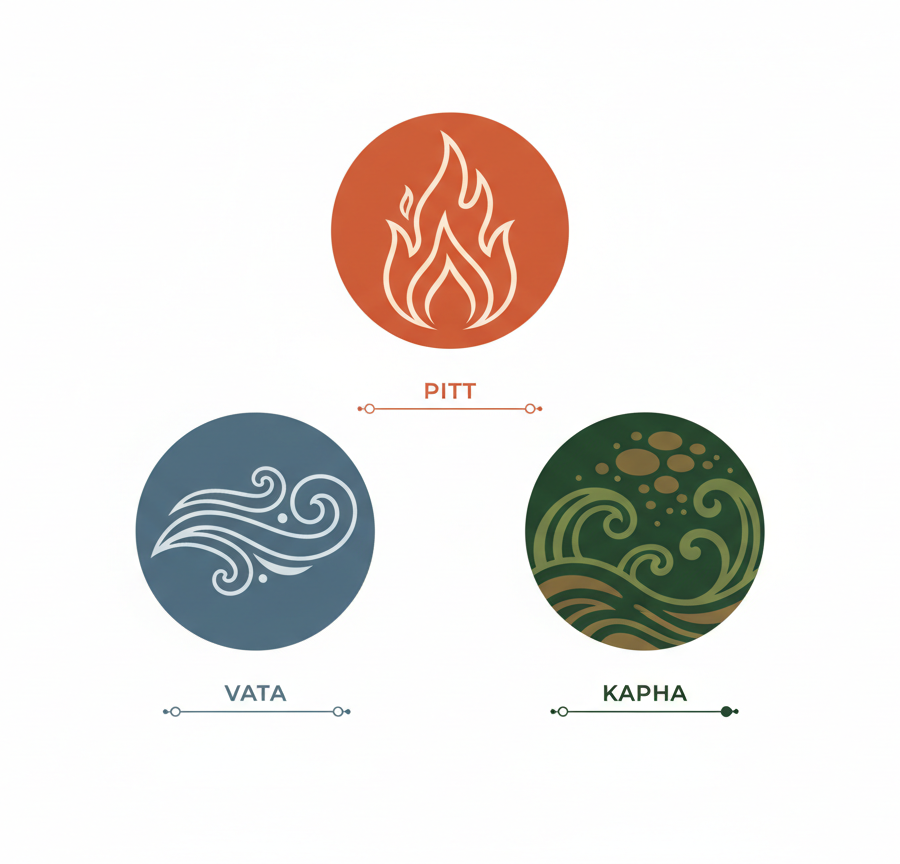
3.1 Vata Dosha (Vāta) — The Principle of Movement
Elements: Air + Space
Governs: Breathing, circulation, nerve impulses, bowel movement, mental processes
Vata people when in balance:
Lively, enthusiastic, creative
Quick learners (and quick forgetters)
Slender build, lively eyes
Vata people when out of balance:
Anxiety, fear, insomnia
Dry skin, constipation, joint pain
Poor concentration
→ Detailed guide: Vata Dosha — complete guide to understanding and balancing
→ Diet for Vata: Ayurvedic diet for Vata Dosha
3.2 Pitta Dosha (Pitta) — The Principle of Transformation
Elements: Fire + Water
Governs: Metabolism, digestion, body temperature, hormones, intellect
Pitta people when in balance:
Intelligent, focused, natural leaders
Strong digestion, warm body
Medium height, athletic build
Pitta people when out of balance:
Irritability, anger, perfectionism
Heartburn, inflammation, skin rashes
Excessive criticality
→ Detailed guide: Ayurvedic diet for Pitta Dosha
3.3 Kapha Dosha (Kapha) — The Principle of Structure
Elements: Earth + Water
Governs: Body structure, immunity, joint lubrication, endurance, memory
Kapha people when in balance:
Calm, patient, loyal
Excellent long-term memory
Strong build, lasting energy
Kapha people when out of balance:
Lethargy, attachment, resistance
Weight gain, congestion, edema
Difficulty starting new things
→ Detailed guide: Ayurvedic diet for Kapha Dosha
→ Seasonal advice: Kapha Dosha in spring — why do you feel sluggish?
3.4 Your combination is unique
Rarely is anyone "pure" Vata, Pitta, or Kapha. Most people have a dominant dosha and a secondary dosha. This innate combination is called Prakriti (Prakṛti) — your natural constitutive type. The difference between Prakriti (who you are by nature) and Vikriti (Vikṛti, your current state) is central to Ayurvedic diagnostics. Disease occurs when Vikriti significantly deviates from Prakriti. Quick tip:
Take our AI Dosha Diagnostics to find out your Prakriti and Vikriti through analysis of tongue, eyes, and face. Free, only a few minutes.
4. Agni: The Digestive Fire that Governs Health
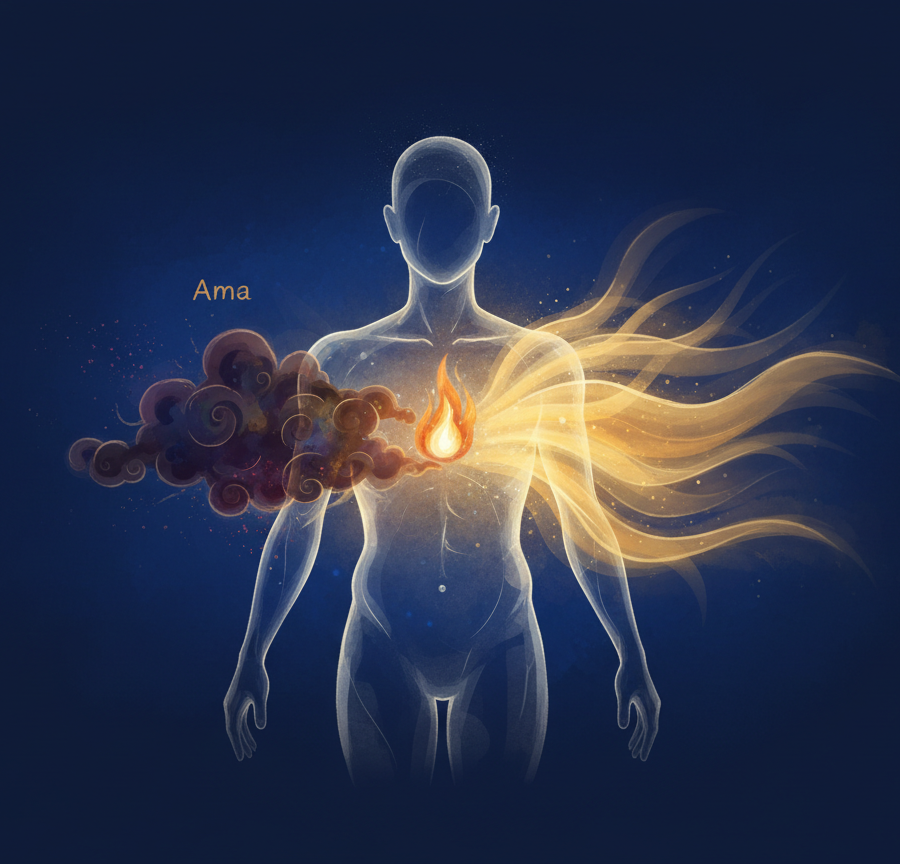
One of the most important concepts in Ayurveda is Agni (Agni) — the digestive and metabolic fire. Ayurveda believes that almost all diseases originate from weak or disturbed Agni. Agni is not just stomach acid. It is the principle of transformation of everything — food, emotions, experiences. When Agni is strong:
Food is digested completely and efficiently
Toxins (Ama) do not accumulate
Immunity is strong
The mind is clear
When Agni is weak, Ama (Āma) accumulates — incompletely digested toxins that are the basis of chronic diseases.
→ Related article: Weak Agni in spring — why do you feel sluggish after winter
→ Related article: Stomach problems: natural solutions
5. Ayurvedic Diagnostics: How the Body Speaks
Ayurveda has its own diagnostic methods that do not require a laboratory. You can practice two of them yourself at home:
5.1 Jihva Pariksha — Tongue Examination
The tongue is the "mirror of the internal organs". Each part of the tongue corresponds to a different organ:
White coating → sign of Ama (toxins), weak digestion
Yellow coating → excess Pitta, bile problems
Dry, cracked tongue → Vata imbalance
Swelling of the tongue → Kapha imbalance, fluid retention
→ Related article: What the tongue says about your health — an Ayurvedic guide
5.2 Nadi Pariksha — Pulse Diagnosis
This is a specialist technique where an experienced Ayurvedic doctor "reads" the pulse with three fingers and identifies imbalances in the doshas. It is available at our
6. Ashtanga Ayurveda: The Eight Branches of Knowledge
Ayurveda is not just "herbs for the stomach". It is a complete medical system with eight specialized areas:
1. Kāya Chikitsā — Internal Medicine
2. Bāla Chikitsā — Pediatrics
3. Graha Chikitsā — Psychiatry and spiritual health
4. Ūrdhvānga Chikitsā — Diseases of the head, eyes, ears, nose, throat
5. Śalya Chikitsā — Surgery
6. Dansra Chikitsā — Toxicology
7. Jarā Chikitsā (Rasāyana) — Gerontology, rejuvenation
8. Vṛsha Chikitsā (Vājīkaraṇa) — Reproductive health, vitality
→ Related article: Ashtanga Ayurveda — a detailed overview of the eight branches
7. Ayurvedic Principles for Daily Life
Ayurveda is not just for when you are sick. It is a preventive science — the art of not getting sick.
7.1 Dinacharya (Dīnacharyā) — The Ideal Daily Routine
06:00 — Wake up before sunrise (Brahma muhurta). This is the "Vata hour" — ideal for meditation and clarity of mind
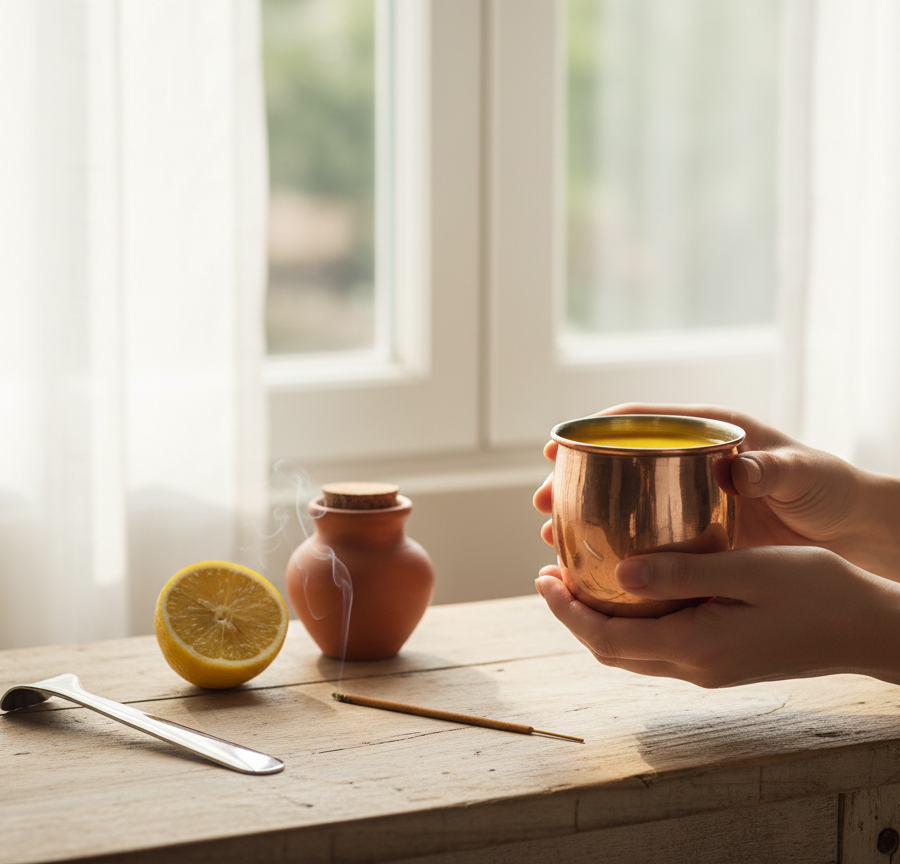
06:15 — Clean the tongue with a tongue scraper (Jihvā Nirlekhana)
06:30 — Drink a glass of warm water or warm water with lemon
07:00 — Abhyanga — self-massage with warm oil (sesame for Vata, coconut for Pitta, mustard for Kapha)
08:00 — Eat a warm, freshly prepared breakfast
12:00-13:00 — Main meal (Agni is strongest at noon)
18:00-19:00 — Light dinner
22:00 — Go to bed. After 22:00 Pitta "wakes up" — if you sleep, the body regenerates; if you are awake, you "consume" that regenerative Pitta
7.2 Ritucharya (Ṛtucharyā) — Seasonal Living
Ayurveda teaches you to change your lifestyle with each season:
Spring → Kapha season. Time for detoxification, light food, activity → Spring detoxification — Ayurvedic guide
Summer → Pitta season. Cool food, avoiding overheating → Ayurvedic tips for summer
Autumn/Winter → Vata season. Warm, oily, nutritious food, more sleep
8. Ayurvedic Herbs and Supplements: The Natural Pharmacy
Ayurveda has a rich Dravyaguna (Dravyaguṇa) — the science of herbs. Here are the most important ones:
The Trophy: Trio for Beginners
Ashwagandha (Withania somnifera) — "Horse power" in Sanskrit. An adaptogen for stress, anxiety, and endurance. The most researched Ayurvedic herb with over 50 randomized clinical studies.
Triphala — A combination of three fruits (Amalaki, Haritaki, Bibhitaki). A universal tonic for digestion, immunity, and detoxification. Ayurveda calls it the "mother and father" of herbs.
Brahmi (Bacopa monnieri) — The herb for the brain and nervous system. Improving memory, concentration, and reducing anxiety.
External source: Journal of Ayurveda and Integrative Medicine — clinical studies

9. Ayurveda and Modern Science: The Bridge
The frequent question is: "Does Ayurveda have scientific support?" The answer is increasingly firm — yes.
Research worth mentioning:
Curcumin (active ingredient of turmeric): Over 3,000 scientific studies. Anti-inflammatory and antioxidant activity has been studied extensively, and some trials have compared it with ibuprofen for joint pain. It is not free of side effects: curcumin can interact with anticoagulants and cause digestive upset. → Curcumin capsules
Ashwagandha: A 2019 meta-analysis (Journal of Evidence-Based Integrative Medicine) confirmed a significant reduction in cortisol and stress among participants.
Triphala: A study in Ancient Science of Life confirmed an antibacterial effect against H. pylori — the bacteria responsible for 80% of gastric ulcers.
Brahmi: A systematic review in the Journal of Ethnopharmacology (2014) confirmed improvement in cognitive functions in healthy adults.
External source: Johns Hopkins Medicine — Ayurveda Overview
11. Ayurveda and Other Systems of Medicine
Ayurveda is not a replacement for conventional medicine — it is complementary. The benefit lies in the synergy.
In our article on alternative medicine and Ayurveda, we examine this issue in more detail.
External source: The Chopra Foundation — Integrating Ayurveda with Modern Medicine
Frequently Asked Questions (FAQ)
What is Ayurveda and where does it originate from?
Ayurveda is a traditional Indian system of medicine over 5,000 years old. The word comes from Sanskrit: Ayur (life) + Veda (knowledge). It originated based on Vedic texts and is today officially recognized by the World Health Organization.
What are the three doshas in Ayurveda?
The three doshas are Vata (air + space), Pitta (fire + water), and Kapha (earth + water). Every person has a unique combination of them — called Prakriti. Knowing your dosha is the key to a personalized approach to diet, herbs, and lifestyle.
Is Ayurveda scientifically proven?
More and more Ayurvedic practices and herbs are being studied in clinical trials. Curcumin, Ashwagandha, and Brahmi have hundreds of randomized studies with positive results. It is important to emphasize that Ayurveda is complementary medicine — not a replacement for conventional treatment in acute conditions.
How can I find out my dosha?
There are two ways: (1) Take our AI Dosha Diagnostics — a free analysis through images. (2) Schedule a personal consultation with an Ayurvedic doctor. The classic approach includes pulse analysis (Nadi Pariksha), examination of the tongue, body build, and psychological profile.
Is Ayurveda safe?
Ayurvedic herbs and practices are generally safe when taken correctly and in recommended doses. Our products are 100% natural, without chemicals and additives. Important: inform your doctor if you are taking conventional medications, as some herbs can have interactions.
How quickly are the effects felt?
Ayurveda is holistic medicine — it builds health, not just masks symptoms. Most people notice improvements in digestion and energy within 2–4 weeks. Chronic conditions require 3–6 months of consistent application.
Does Ayurveda treat chronic diseases?
Ayurveda offers natural support for numerous chronic conditions — arthritis, thyroid gland, diabetes, psoriasis and many more. However, it is important to point out: Ayurveda is support, not a diagnosis or a replacement for medical care.
Conclusion: Your First Step
Ayurveda is not a trend. It is 5,000 years of accumulated knowledge about how the human body functions — knowledge that modern science is increasingly confirming. The key principle is simple: Know yourself. Know your dosha. Live in harmony with nature.
Your first step today:
→ Take the free AI Dosha Diagnostics — 5 minutes, personalized analysis
→ Explore our Ayurvedic products — authentic, certified
→ Read the guide for your dosha — Vata | Pitta | Kapha
Scientific sources and references
World Health Organization (WHO) — WHO Traditional Medicine Strategy 2019–2025
National Center for Complementary and Integrative Health (NCCIH) — Ayurvedic Medicine: In Depth
Journal of Ayurveda and Integrative Medicine (J-AIM) — Elsevier
Pratte MA et al. (2014) — An Alternative Treatment for Anxiety: A Systematic Review of Ashwagandha
Pingali U et al. (2014) — Effect of Withania somnifera on cognitive and psychomotor performance
In this guide
More on Doshas & Basics
- The Right Beverage for a Healthy Life: Balance Your Doshas4 min
- Ayurvedic Diet for Pitta Dosha: A Complete Guide to Balance and Health7 min
- Diet according to body shape: How to eat properly depending on your body type9 min
- What does the tongue say about your health? | An Ayurvedic guide5 min
- Ayurvedic Diet for Kapha Dosha: A Complete Guide to Balance and Weight Loss6 min
- Ayurvedic Diet for Vata Dosha: A Complete Guide to Balance6 min
- Vata Dosha: A Guide to Understanding and Balancing6 min
Available in the US
Products in this area of wellness
Traditionally used in the areas this article covers. They are not treatments for any condition, and nothing here is a recommendation for you specifically.
Disclosure: some links below are affiliate links. If you buy through them, AyurvedaGrid may earn a commission at no extra cost to you, and those products are listed first. Which products are relevant at all comes from the topic of the article — nothing here is a recommendation for you specifically.
- Moringa Oil Capsules Super Food Extract(opens in a new tab)affiliateSri Sri Tattva USA· Capsule
General wellness; no single focus — daily superfood nourishment
- AyushMulti(opens in a new tab)Ayush Herbs
General wellness; no single focus — daily multivitamin
- Green Essentials Capsules(opens in a new tab)Planet Ayurveda· Capsule
General wellness; no single focus — daily antioxidant greens
These statements have not been evaluated by the Food and Drug Administration. These products are not intended to diagnose, treat, cure or prevent any disease. Speak to your own healthcare provider before starting a supplement, particularly if you are pregnant, nursing, or taking medication.
Continue reading
 Ayurveda
Turmeric as a Remedy: Benefits, Uses, and Best Recipes
This blog post serves as a comprehensive guide to the power of the "golden spice" – turmeric. The text explains in detail the anti-inflammatory and antioxidant properties of curcumin, its application for chronic pain, digestive issues, and boosting immunity. In addition to scientific facts, the post offers practical recipes for "golden milk" and tea, as well as recommendations for high-quality supplements for maximum results.
 Ayurveda
Natural home remedies everyone should know: Your kitchen as a pharmacy
Discover 19 simple and powerful home remedies from your kitchen that help with coughing, digestive issues, headaches, and boosting immunity. Learn how the ancient Ayurvedic wisdom can help you improve your health in a natural way.
 Ayurveda
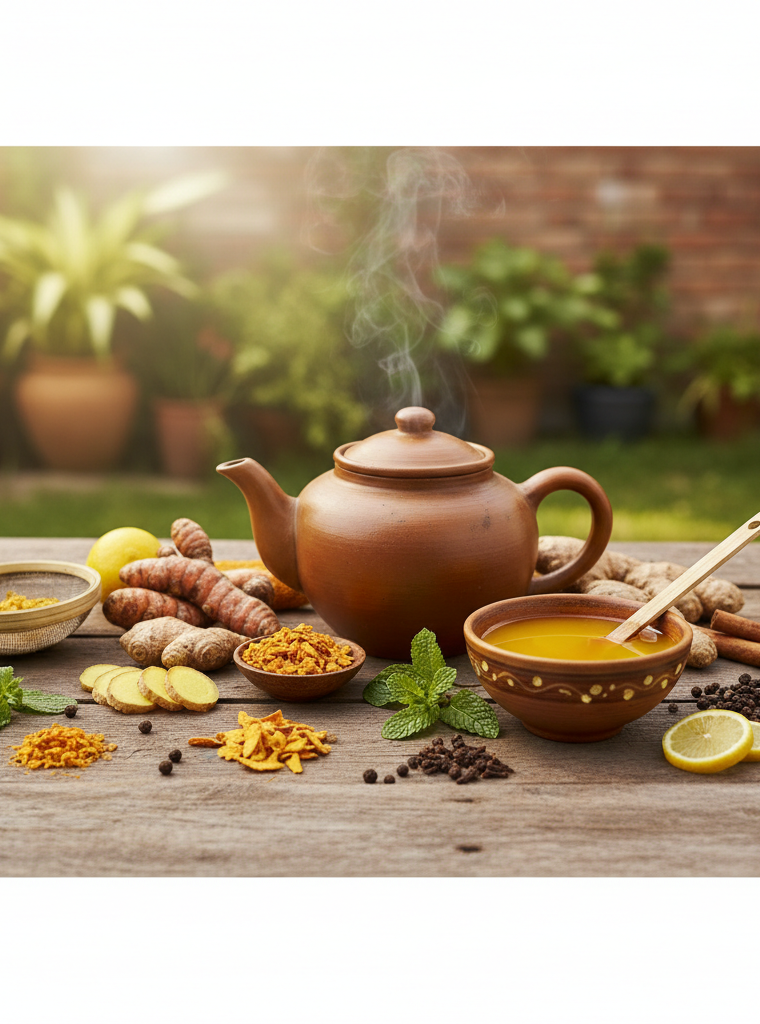
Turmeric and Ginger Tea: A Warming Drink for Cold Season
This guide explores in detail the synergistic impact of turmeric and ginger on the human body. In addition to the traditional Ayurvedic cold tea recipe, the text provides scientific evidence for the power of curcumin, tips for its maximum absorption using black pepper, as well as the benefits of using highly concentrated dietary supplements for long-term health.
Your Ayurvedic overview
Curious about your own constitution?
Take the free guided assessment and receive your personal Ayurvedic overview — about ten minutes, private to your account.
Start Your Journey